
On Care and Close Reading
When Mother's Day and Teacher Appreciation Week Collide

1.
I learn about Teacher Appreciation Week from S., a fellow kindergarten room mom. Technically, we’re “room parents,” but—surprise, surprise—all moms. It’s Wednesday, and we’re down to the wire: Should we collect funds to buy gift cards for the two educators candling chick eggs? Organizing a “grandest persons” celebration? Overseeing an alphabet-inspired, end-of-the-year countdown, welcoming Legos and teddy bears and all manner of “Favorite Things” onto rug time with eighteen classroom days left in the school year while continuing to teach addition and subtraction and reading, following directions and listening, imparting vocabulary like “proboscis?”
(“Butterflies,” my son told me, “they have a tongue called that.”
“That’s right!” I replied, trying to play it cool. “That’s a great word!”)
“Fantastic idea!” I admire S.’s built-in mental calendars of holidays. “I’ll email parents to chip in.” I ask S. if she can get gift cards, since I’m in Los Angeles for work, two thousand miles away from the living room where my son gave me a vocabulary lesson.

2.
Teacher’s Appreciation Week isn’t on my radar, but Mother’s Day is. I’ll be out of town for that, too.
To be clear, “in Los Angeles for work” means I am a tenured professor in a mid-residency MFA program, where I’ve been faculty since 2016. In other words, a teacher. Here I am, leading the last fiction workshop of the semester, hosting a reading, gearing up to attend commencement, running a program assessment meeting, and checking off a handful of other tasks like registering new students for the summer term. In other words, I’ve been working like a maniac. I’m also thirty-three weeks pregnant.
I’ve been a mother for almost seven years, a fraction of the eighteen I’ve taught, and yet, I’m quicker to call myself a mother than a teacher1, quicker still to call myself a writer. A writer and a mother, a mother and a writer.
I don’t think about mothering my students; I think about how I’ve been mothered in the classroom, on the page.
It’s contemplation driven by transformation. I’m on the cusp of being on “baby time” all over again. Occasionally, I find myself daydreaming about that period with my son: drowsily inhaling his milk-breath and cradling his warm, fragile neck after he dozed off nursing; the crisp whisper of pages turning while I read, propped up by pillows on the couch in our small, one-bedroom apartment west of campus. Shortly after he was born, fires raged in Los Angeles; friends texted images of the sky over the 405 stained apocalypse orange. We closed the windows to keep out smoke, ran the air conditioning all fall.
So much will be different with this baby: his big brother, Chicago, summer. The anticipation inspires a kind of inverted nesting, a ruthless desire to weed out the past. I get S’s. text while I’m on the bus, heading to campus to tidy my office. It’s a project I’ve avoided for years. In the stuffy, deserted second-floor cubicle, I toss dried-out dried erase markers; exam materials that predate my hire; a plastic bear, belly full of solidified clover honey; Newman’s Own dark roast Keurig pods (expiration date: 06/2020); unclaimed student ID cards and flyers from the reading series I coordinated as a new visiting professor, another lifetime ago. Novel manuscripts I printed out, marked up, rewrote, set aside. Wordcount charts. Stacks of notebooks containing vocabulary lists, to-do lists, goals, quotes from books I read, sentences I barely remember writing.
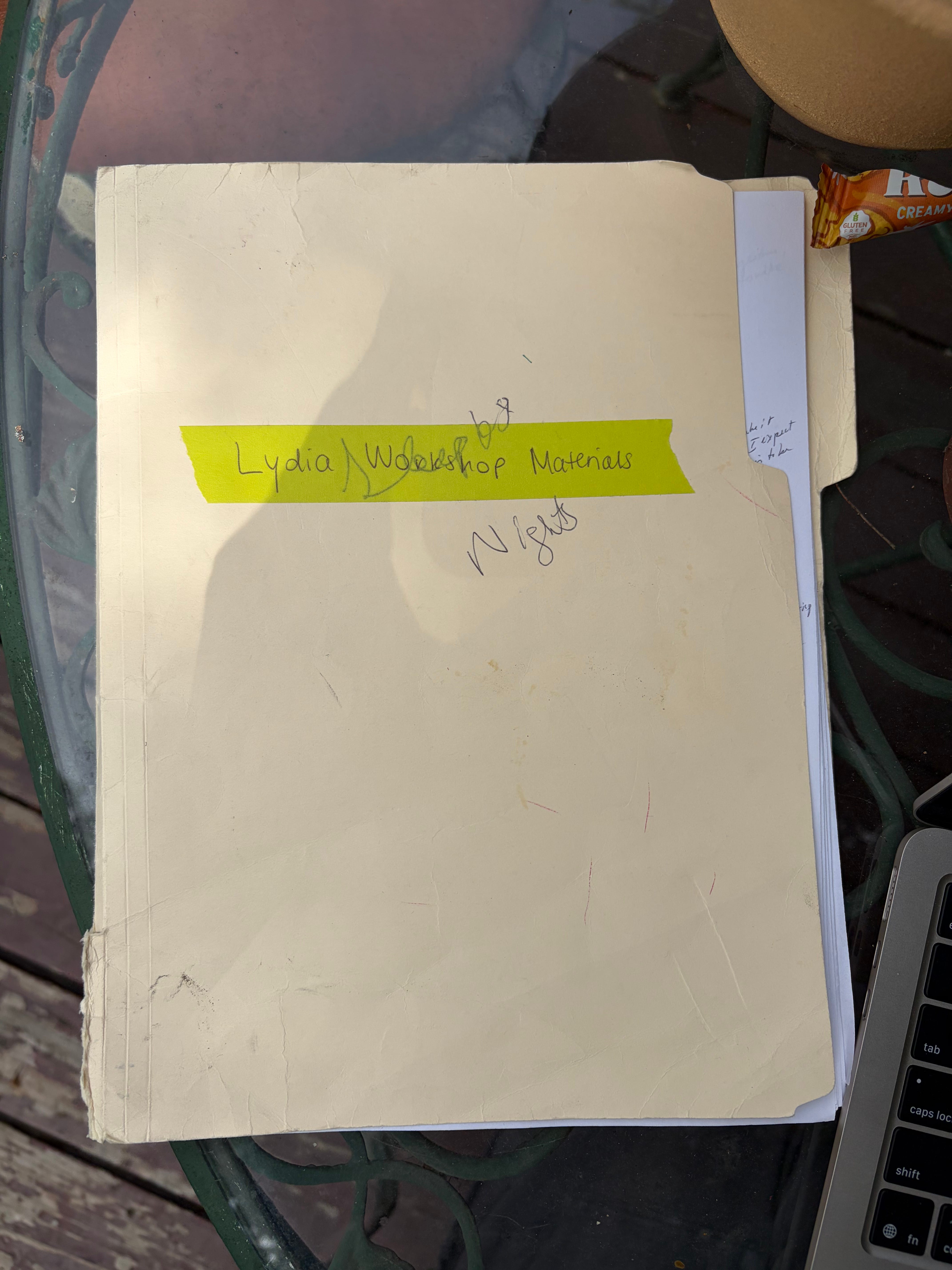
Tucked into one of those stacks I find a thin manila folder. Its frayed spine is downy soft, its front cover dashed with lines of magenta nail polish and pencil smudges. The label, a strip of neon green painter’s tape, reads: “Lydia Workshop Materials.”
3.
In August of 2015, two months before I applied for the job in California, I enrolled in a Fiction Master Class Workshop taught by Lydia Davis at the New York State Writers Institute, an organization housed at SUNY Albany. At the time, my husband and I were living in Western Massachusetts—I’d recently completed an MFA in Poetry at UMass Amherst. Four years prior, we’d relocated from Albany, where my husband had been a PhD student at SUNY.
Lydia Davis was on his committee. She was his mentor—he’d applied to the program to work with her. I was always envious. During my previous MFA, studying Fiction Writing, I had a brief experience with Lydia; she was a visiting writer for two weeks at Washington University. At a festive Thursday night reading, she told the audience how she had traveled with her adolescent son—they visited the Cahokia Mounds. Among my cohort, her presence was polarizing. Many students left their one-on-one manuscript consultations with her, frankly, flabbergasted. Unlike previous guest writers, whose notes centered on character development and pacing and narrative arc, Lydia conferenced about … sentences. Clauses. A handful of words.
For an hour.
I was party to the same treatment. We met in the first-floor living room of an elegantly nondescript two-story home on Pershing Avenue, a university property where visiting writers stayed. I sat on a cloud-blue settee; she sat in a leather-backed chair. Consulting the hard copy of my manuscript—a twenty-five-page short story in a series of vignettes—Lydia methodically worked through several paragraphs of annotations: penciled circles and checkmarks, margins notes citing both primary and secondary definitions from the dictionary. Diction wasn’t a matter of copy or line editing, I realized, listening to her patiently discuss a questionable word choice, one I’d arrived at haphazardly—or, as I probably thought at the time, intuitively. Diction was care.
Several years later, at the long dining room table in Lydia’s house, I experienced that same care as she discussed my husband’s prospectus on the ethics of character in David Foster Wallace’s fiction. Firmly, she pointed out moments where jargon obscured; where phrasing was wooden or empty; where the material terms of a thought were holey or weak, and, as a consequence, the argument might collapse. She served us tea and rugelach, then showed us around her converted schoolhouse home. From her office, which had at least one and possibly two dictionary stands, a bank of windows looked out on a pasture, where she had been observing cows.
All of this led me to apply for the Master Class Workshop in 2015, even though attending the five, Tuesday-night sessions would require driving two hours from our home in Greenfield, Massachusetts to the Uptown Campus of SUNY, 140o Washington Avenue; hustling across the wind-tunnel of a parking lot; and getting to the New York State Institute for Writers Conference Room tucked in a corner of the third floor of the Science Library, by 6 p.m. Workshop would run three hours. Then, I’d drive back home through the dark, desolate Berkshires, hopefully crawling into bed before midnight, so I could wake up and commute fifty minutes to teach my 8.a.m Monday-Wednesday-Friday college writing class.
Mid-September, I received an email, congratulating me on being selected to participate. Joshua, the coordinator, asked for volunteers for the first workshop, and relayed an assignment from Lydia:
For the first class meeting, please make a list of all your reading over the past year, as far as you can remember it. Include magazines, newspapers, and websites, but most importantly, books. If you have read only part of the book, please do include it, but indicate this. If the book was for a course, please indicate. You might also put an asterisk next to the titles that were particularly important or interesting to you.
I was thrilled. Yes, I’d finished a second MFA; yes, I was regularly publishing my work in magazines and literary journals; I was revising a novel; I was teaching. My excitement wasn’t about a stamp of approval or another workshop—I’d been packing my academic schedule with workshops since junior year of high school. My excitement stemmed from being in proximity to Lydia, who I viewed as a model of focus and discipline, whose understated brilliance and uncompromising rigor I revered.
4.
I don’t usually call my mom when I’m teaching in LA. There’s the CST-PST time zone complication, and when I’m here, I try to take advantage of being free from the daily responsibilities that I can’t avoid in my home office—walking the dog, making sure the gym-day uniform and the non-gym day uniforms are washed, adding to the calendar the field number and jersey color for this Sunday’s soccer game. Or calling my mom.
“Can you hold on?” she asks. “I need the girl to scan my phone.”
Of course, I say. I watch a woman in narrow sunglasses and a white, ankle-length Gunne Sax-style dress slide into a gleaming Volvo, still sporting paper plates. I expect the car to reverse. Instead, it pulls up a long driveway that seems to have no end.
My mother is back. She’s checking out at Whole Foods: it’s the best and worst time for a call. Likely, she’s purchased something delicious; likely, she’s distracted. Maybe she and my dad will make turkey tacos for dinner. She asks about my health—it feels like I’ve been getting over a cold for this whole trip. She compliments me for making a follow-up doctor appointment. She asks if I’m enjoying myself. Am I eating at any special restaurants? Going to the beach?
I don’t explain that I’m on the east side and the beach is on the west side. I don’t tell my mother to watch for flowers, though I’ve ordered her bouquet. I tell her I’m having a good time; right this moment, I’m walking to meet a friend at a bookstore. I don’t mention my job. I don’t mention my writing.
“You love LA,” she says insistently. “You won’t be able to travel like this for a couple years. I hope you’re taking it easy. Not just working and working.”
I move slowly, breathing in the jasmine, the first smell I noticed when I flew out for my campus interview ten years ago. It was utterly new to me, an intoxicating mix of cotton candy and bubblegum. My mother and I had hung up before that, I think.
5.
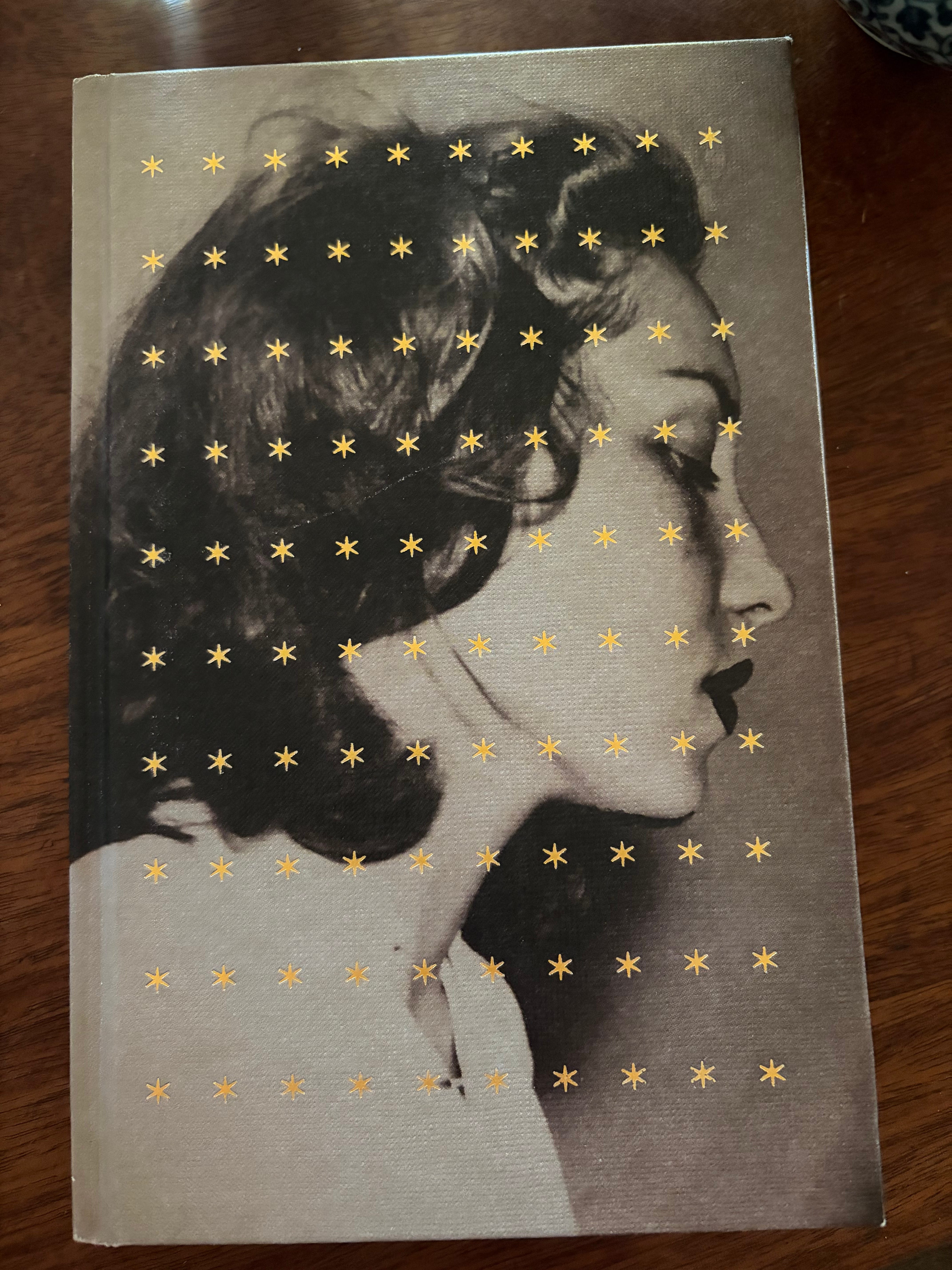
Late-day sunlight turns the green golden, palm trees and cacti and succulents and jasmine vines glowing. On the bus the other day, I read a beautiful New Directions edition of Clarice Lispector’s last novella, The Hour of the Star, which I’d found in the time warp of my office. Before beginning, I jumped to the “Reminiscence” by her son, Paulo Gurgel Valente. “Among so many writings of my mother’s that I admire, I read and reread The Hour of the Star,” he wrote in July 2020, “always finding new ways of understanding it, of thinking about it—line by line, laughing, in constant admiration.”
6.
The reading list I brought to the first session of the NYS Writers Institute Master Class, which I found in my desk in Los Angeles, indicates I had recently read “a few short stories” by Clarice Lispector. I don’t recall which ones. The first night of the workshop, our group of eight gathered in the third floor conference room. A sense of being somewhere remote and special, hidden at the end of a twisty hallway in this obscure corner of the Science Library. Muted lights reflecting off the polished wooden table, a reverent stillness as Lydia sat down, organized her papers, and uncapped a bottle of water.
We must have discussed our reading lists; we must have workshopped the first stories—in this class, students could turn in three at a time. In the folder, I have Lydia’s notes on the three I submitted, as well as her notes on a page of journal excerpts, the observational sort that Lydia herself practiced recording in a notebook, while on a train or in a hotel lobby. At the bottom of the paper, she writes, “Nice dialogs,” she writes, “No metaphors?”
It’s true.
There’s overheard post office chatter, a sign on a tire shop marquee: “Don’t look back you’re not going that way.” Below an exchange between my father and mother—“I didn’t marry a stranger”—Lydia writes, “Yes, nice—esp. w/more context.”
I read through her notes on the short stories[2]. A string of words, underlined, (“day, today, her”) paired with a margin note: “sentence structure difficult.” A colloquialism (“see so”) underlined, question-marked, and commented upon: “interesting …” As I page through the stories, I realize I’m not reading my prose, which feels inert, ossified; I’m reading for her thoughts and edits—there are so many of them—which seem to vibrate on the paper. They’re a guide. To becoming a better writer and a better teacher and a better reader. Perhaps to becoming a better mother. Because mothering is about reading. About being sensitive to the nuances of tone and expression. About understanding where a description (“her mother’s grim lips”) might be communicating something deeper and affirming that. Check.
7.
I think I missed a workshop; I can’t remember why. Or maybe I prided myself on attending all five. I have no recollection of the other students in the group or the writing they submitted, even now, trying to return to those Tuesdays in that room. And yet I’ve mentioned the workshop dozens of times over the years, to my own students, because what I do remember is how she read.
We read to diagnose each sentence—its purpose, how it operated. There were five categories of narration, Lydia explained: Action, Comment, Description, Dialogue, and Exposition (backstory). We diagnosed each sentence in each story. “There will often be some overlapping between categories,” she wrote on the one instructional handout she distributed. “Some Things to Look at in Close Reading.”
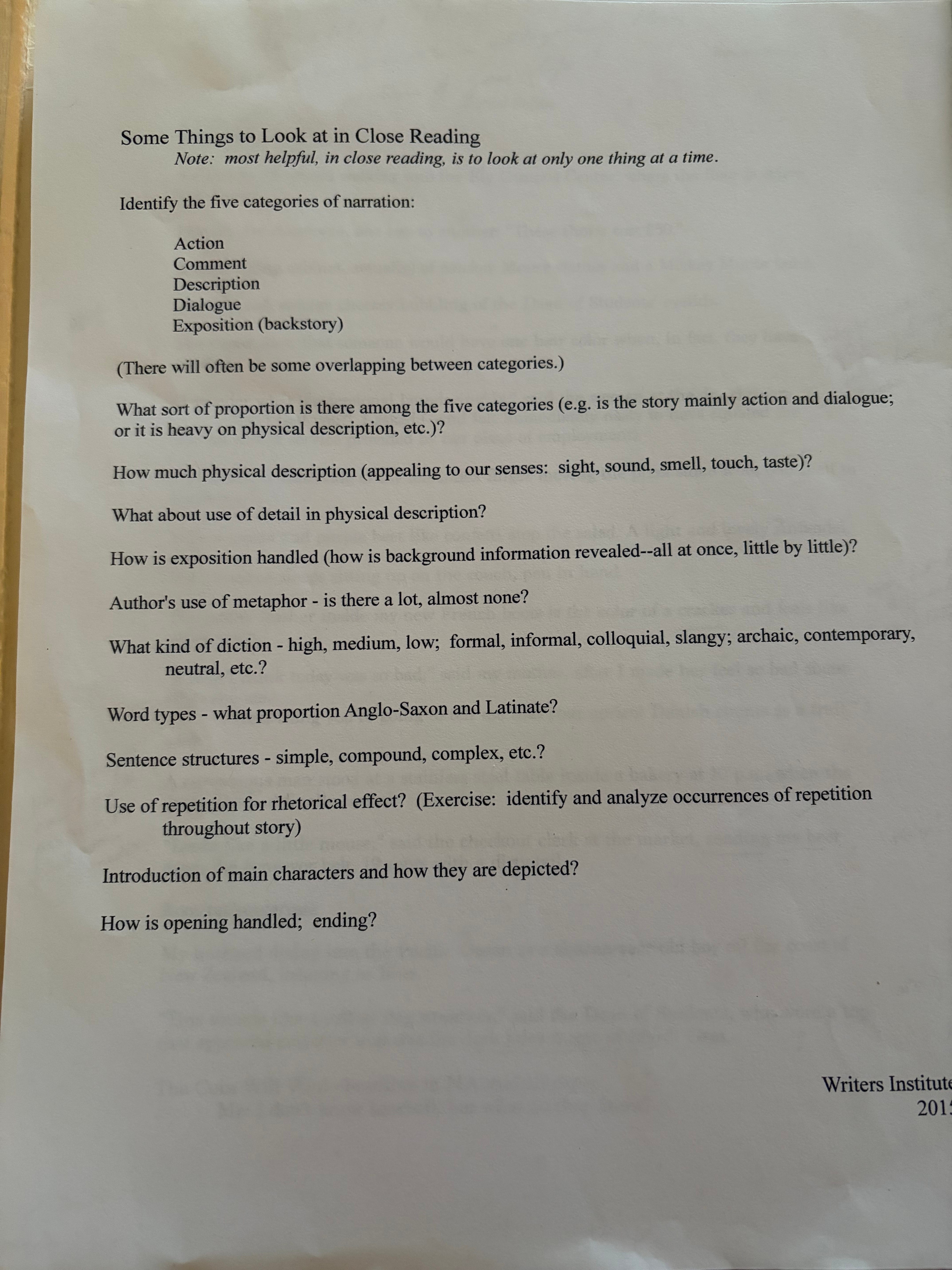
The terms are so seemingly simple, the practice so concrete—that still strikes me. (Though, as Lispector writes in The Hour of the Star: “Make no mistake, I only achieve simplicity with enormous effort.”) No thorny narrative theory, no riffing on the larger themes or politics. Aesthetics and grammar. What the inclusion of detail or figurative language might mean. What its absence suggests. What it means to teach someone—a student, a child—to slow down, pay attention, and care.
8.
At the beginning of the fiction workshop I taught last Sunday, a student handed me a greeting card and told me to check my email. During our break, I opened the envelope. I was surprised discover a card congratulating me on my pregnancy.
I looked out at the empty chairs, at the jasmine bushes out the window; I thought about parched birds-of-paradise I’d passed on my way into campus. I thought about my son in Chicago, donning his red uniform for the soccer game.
“May God bless you and your family,” the student wrote. “Thank you for all you have done for me in the MFA program.” In my inbox, there was a gift card.
When the students returned to the classroom, we resumed our line editing workshop. It was a hybrid course, so this was only the third time we’d been together, in person, since January.
“I haven’t written on the blackboard all semester!” I exclaimed, standing up.
For a moment, I felt self-conscious approaching the blackboard, big pregnant belly in profile. Then, I picked up the chalk and wrote, in all caps: WHAT IS IT DOING?
This was the question we needed to ask ourselves of every choice we made in our writing, especially during revision, I said. Satisfied, I sat. I mentioned Lydia’s categories of narration, explaining none of this was so neat. Dialogue could be description; dialogue could be action. “There will often be some overlapping between categories.” Underneath the desk top, the baby kicked.
Might I identify differently if I were an elementary or middle school or high school teacher? Does the language of instructor/lecturer/professor estrange me from that identifier? Or the fact that, like most academics, I hold no teaching certification and completed no education courses, but, rather, wound up where I am by a combination of degree conferral, publication, and baptism-by-fire underpaid, TA labor?