
"You Can Make Something, Even When You Pack Your Kid's Sandwich": Juan Martinez on Infusing Parenting with Creativity
Plus, the gory, glorious catharsis of horror fiction; the pleasures of long-form narrative; sketchbook micro-therapy; and inadvertent bohemianism


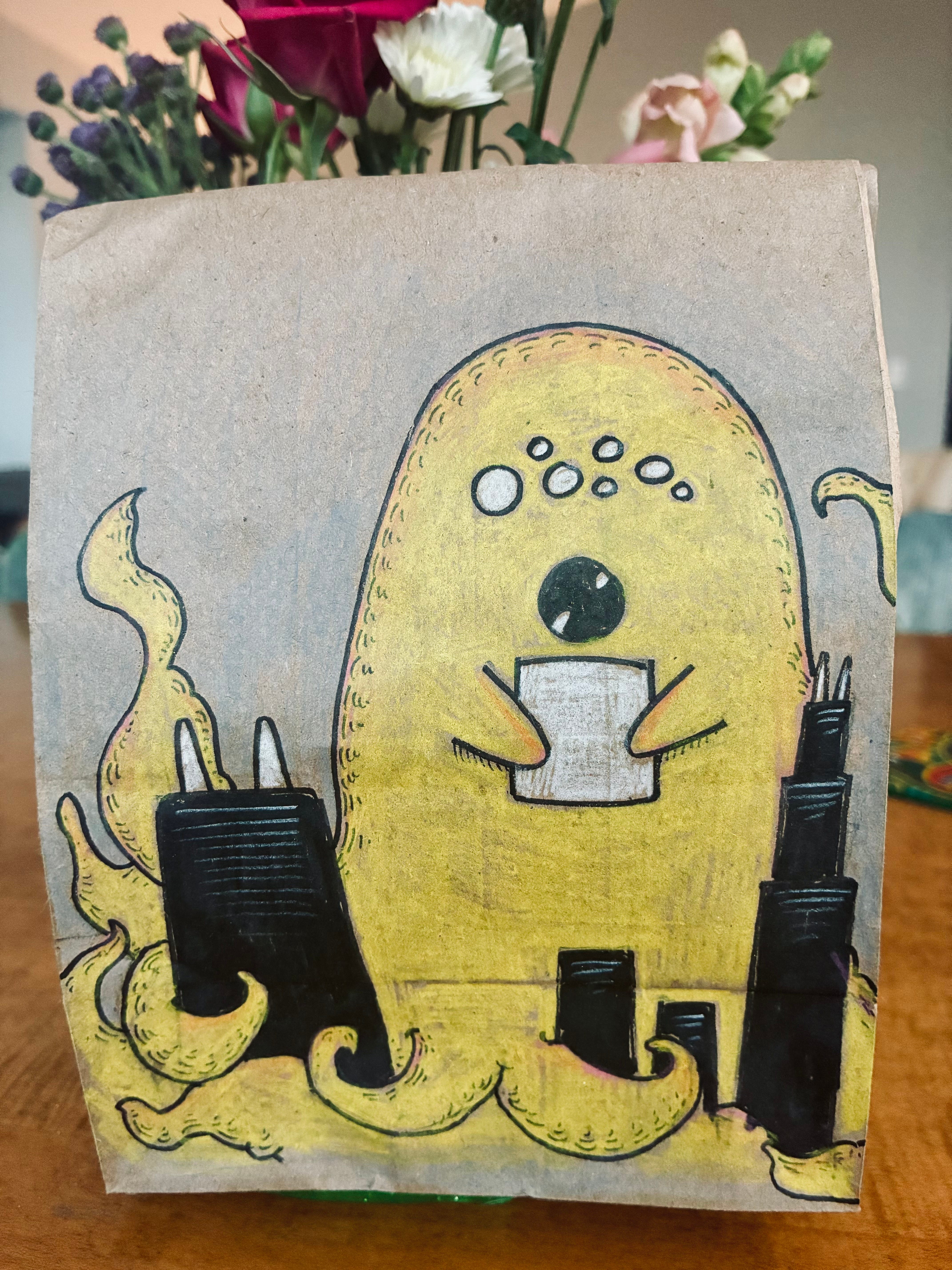
Continuing a monthly-ish series of conversations with artists, writers, and creative people about their formative experiences with art and culture, plus how they think about sharing art and culture with the children in their life. This week: Juan Martinez, author of the horror novel Extended Stay (University of Arizona Press / Camino del Sol, 2023) and the story collection Best Worst American (Small Beer Press, 2017). An associate professor of English at Northwestern University, Juan lives with his family near Chicago, where he makes the most spectacular lunch bag doodles you’ve ever seen.
JoAnna Novak: You’re a fiction writer who works in speculative and fabulist spaces.
Juan Martinez: Those are my happy places.
JN: How did childhood experiences with art and culture get you interested in those genres?
JM: I read everything when I was a kid. We were living in this worker’s camp in Venezuela during the oil boom, from like age zero until I was seven or eight, because my dad was working on what would become, when completed, the world’s second largest dam. I grew up alongside all these American kids whose parents also worked for the same project. And these American kids, it turns out, had the best toys. Plus, they had access to this huge library of really awesome movies, all these Betamax tapes that would get shipped down to the middle of the jungle, just for them. They also had great books, all shipped in from the States. So I borrowed all their toys, their movies, and their books, and I grew up reading a lot of Nancy Drew and all sorts of other amazing novels, just anything and everything that ended up in the jungle.
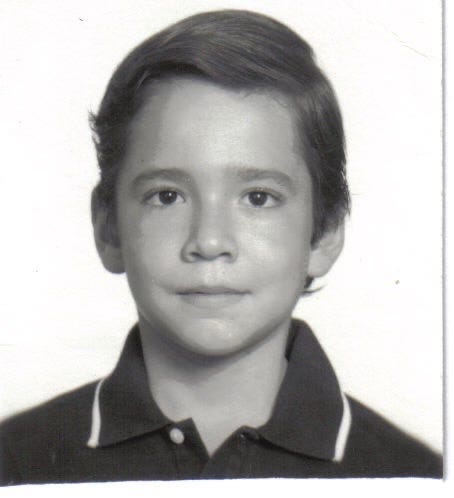
But my love of horror really started when I was about 12—I was misdiagnosed with Duchenne muscular dystrophy. It was almost a year of me being bedridden, having trouble swallowing, walking up the stairs, the whole condition rapidly deteriorating, all of it heading, we all felt, inevitably towards death. During that time, I read Stephen King and Peter Straub and a bunch of horror writers that I fell in love with. That was a formative moment for me. It was this very intense love of the genre at a moment where I thought I was going to die and there was a very clear sort of cathartic, healthy delight in watching people get flayed or decapitated or just have horrible things happen.
So, that’s where it started. What’s kind of funny is that it took me such a long time to reconnect with that 12-year-old. Like, practically a whole other lifetime.
JN: Why do you think reconnecting with that 12-year-old took so long?
JM: A couple reasons. One of them is I that started reading more broadly. When it turned out that I wasn’t going to die, when we learned I’d been misdiagnosed, I moved on: I graduated from high school and started dropping out of colleges, both in South America and North America. I discovered Philip K. Dick. Then—it’s weirdly specific—I stumbled on the 1990 edition of Best American Short Stories, the one edited by Richard Ford, in a lending library in Bogotá. I picked it up because I must have run out of Philip K. Dick. And I fell in love with what literary short stories can do. I discovered Steven Millhouser because “Eisenheim the Illusionist” was in that anthology. Cynthia Ozick, too. It was a really amazing introduction to the beautiful little jewels of short form. I took a turn and that’s all I read for a long time.
Eventually I did end up going back to college and getting an MA in creative writing. It was an interesting time to be in grad school. I had terrific professors, but I lost count of how many times was I assigned Tim O’Brien or Raymond Carver. There was, for whatever reason, a feeling that there was just one right way of doing fiction. There’s something sort of vaguely embarrassing about anything speculative and so I kept that love to myself. I think I internalized a lot of that prejudice that one form was lesser than the other, though of course I had a professor who introduced me to David Foster Wallace, another to Louise Erdrich—writers who both trafficked in genre conventions and who celebrated genre authors. So I want to make sure I’m not making this feeling wholly about some kind of institutional pressure. It wasn’t. I’d just gotten to a point where I wanted to be, you know, capital-S Serious. And I believed literary fiction was what I needed to do, because that one form privileged language and the other privileged awesome, gruesome decapitations.
I eventually got my PhD in literature, in Las Vegas, but I had been publishing a lot of short stories while working on my dissertation. They were fabulist, absurdist, sort of on the edge of what we could even consider a story. My first publication was for McSweeney’s. Goofy, funny, kind of metafictional. And I ended up, post-graduation, as a visiting professor at Whitman College; I landed this amazing gig with these awesome people in Eastern Washington and I knew that I was supposed to start writing a novel. So I did what people do, which is I tried writing the novel I thought I was supposed to be writing. It was about somebody who’s vaguely sad…that might’ve been it. I was so bored with it I’d start cheating on that novel with what I ended up thinking of as my “just for fun” project, which was like The Shining, but in Las Vegas with two undocumented Colombian siblings as protagonists. Of course, that “just for fun” novel immediately had like 50 pages within the first week. And the sad novel just kept getting sadder by the day—it was sad in both page count and content.
JN: The 12-year old’s taste won out after a long struggle.
JM: I invited Rebecca Makkai to talk to our Northwestern undergraduates, and she had this brilliant, off-the-cuff insight about reading—how reading changes as you get older. She said, “You never read as intensely as when you’re twelve.” Listening to her, having her center that primal reading experience, was a really good reminder. I go back to the question at the heart of that insight all the time, both as a writer and an educator: I ask them, ask myself, what activated you as a kid? What made you excited about stories?
JN: You’re a father. How old are your kids?
JM: My son is 10 years old and my daughter is four.
JN: As a writer yourself, how do you think about introducing them to arts and culture, those really fundamental parts of your life and worldview?
JM: What’s kind of cool is that both me and my wife are writers. But also: we’re writers, so we can’t really afford much childcare. So our kids see us working all the time and they know that this is what we do for fun and profit.
My son in particular is really proud of the fact that I write horror because he likes that idea—he’s excited about scary things. He keeps coming up with ideas for me that I should do horror stories about. He’s got a great imagination, but writing isn’t his passion. He’s a huge reader, but he’s a systems guy. He likes engineering. He likes architecture. He loves astrophysics.
We go to the library all the time. We pick up graphic novels. He loves graphic novels. He’s really into great chapter books, but he’s also big into Minecraft. And one thing that I’m grateful for is how that particular franchise has excellent graphic novels and really weirdly good chapter books—Max Brooks authored some of them, after he did World War Z. My son isn’t here, so I can say this: Minecraft, the movie, is not the greatest video game to film adaptation. But that aside, there’s all these amazing entry points into stuff. He’s into the Warriors series, which is like Lord of the Rings, but with clans of dueling, feuding kitty cats—there’s like 40 novels. They’re kind of amazing in their complexity, just this baroque world you can lose yourself in for hours, complete with elaborate maps. He shares our enthusiasm for long narratives, and I don’t know if it’s built-in or if it’s by osmosis, if it’s nature or nurture or what.. That’s been really, really cool to see develop. I don’t think that he wants to be a writer himself—I don’t think he wants to be an artist in that particular way—but he clearly loves it and he sees why it’s special.
Our daughter, on the other hand? Total art school kid. The other day we said no to something, like, “No, you can’t bring that stuffy to the gym because this is your favorite stuffy and you’ll lose it.” And she immediately grabbed a piece of paper and drew herself with a broken heart. And then she drew the stuffy—and she drew a broken heart on the stuffy. She walks around with this cheap digital camera that my sister got for her and just takes photos of everything, mostly close ups of people’s noses.
JN: I love that impulse—when, when met with a “no,” hit the sketchbook.
JM: My wife kind of figured it out. Maybe a year ago, our daughter was inconsolable about, I don’t know, probably something awful we said to her, like no, you can’t put a hat on the cat. Or she was inconsolable about the cat not wanting a hat put on him. What I’m saying is, she has big feelings. She’s on the tiny side and I think that it helps to be explosive in your affect to make sure that people listen to you. And there was one moment where she was very angry about, let’s say, some cat or hat situation. And my wife said, “Well, you could draw how you feel.” And my daughter ran to her art supplies and her hair was covering her face, like she was one of the ghosts in a Japanese horror movie, and she was scrawling her feelings and it made her feel better. She was fine five minutes later.
JN: That’s amazing. Can we backtrack? You mentioned that your son likes to give you ideas.
JM: Yes.
JN: Do you ever pursue them?
JM: I’ve jotted a couple down because they are pretty good. But I know you’re also a writer…and the ideas that get pitched! I’m sure this has happened to you in an airplane or something, right? People ask, “What do you do?” When you say you’re a writer, they go, “I’ve got a story for you.” And of course, I love my son, I love that he’s offering me story ideas and they’re really good, but…I’ve got my own ideas.
I think, though, that I am going to try and do a collaboration with him on a middle-grade novel. I don’t know if you know the writer Belle Boggs. She teaches at North Carolina State University. She’s got an amazing Substack that she co-writes with her daughter, and they recently did really cool book for younger readers, and Belle herself has now written a terrific middle-grade novel.
JN: I’ll look into that. I love the possibility of these parent-child collaborations!
JM: It had never entered my mind before kids. And seeing Belle’s collaborative work, both on Substack and beyond, just seeing her and her daughter working together—that’s just really cool. It reframes how I see the world. I get caught up in so many of my own preoccupations and obsessions, and other artists’ collaborative modes, their family-friendly approaches, do make me stop and go, “Oh, wait a minute. This is something I can do together with one of my favorite people in the world.”
JN: That’s so cool. Growing up, my parents introduced me to a lot of art and literature and film and music, but we didn’t participate in those pastimes, creatively, together. Now, as a mom, when I interact with my son, I always try to be in the metaphorical sandbox with him. How did your parents talk to you about art, literature, etc.?
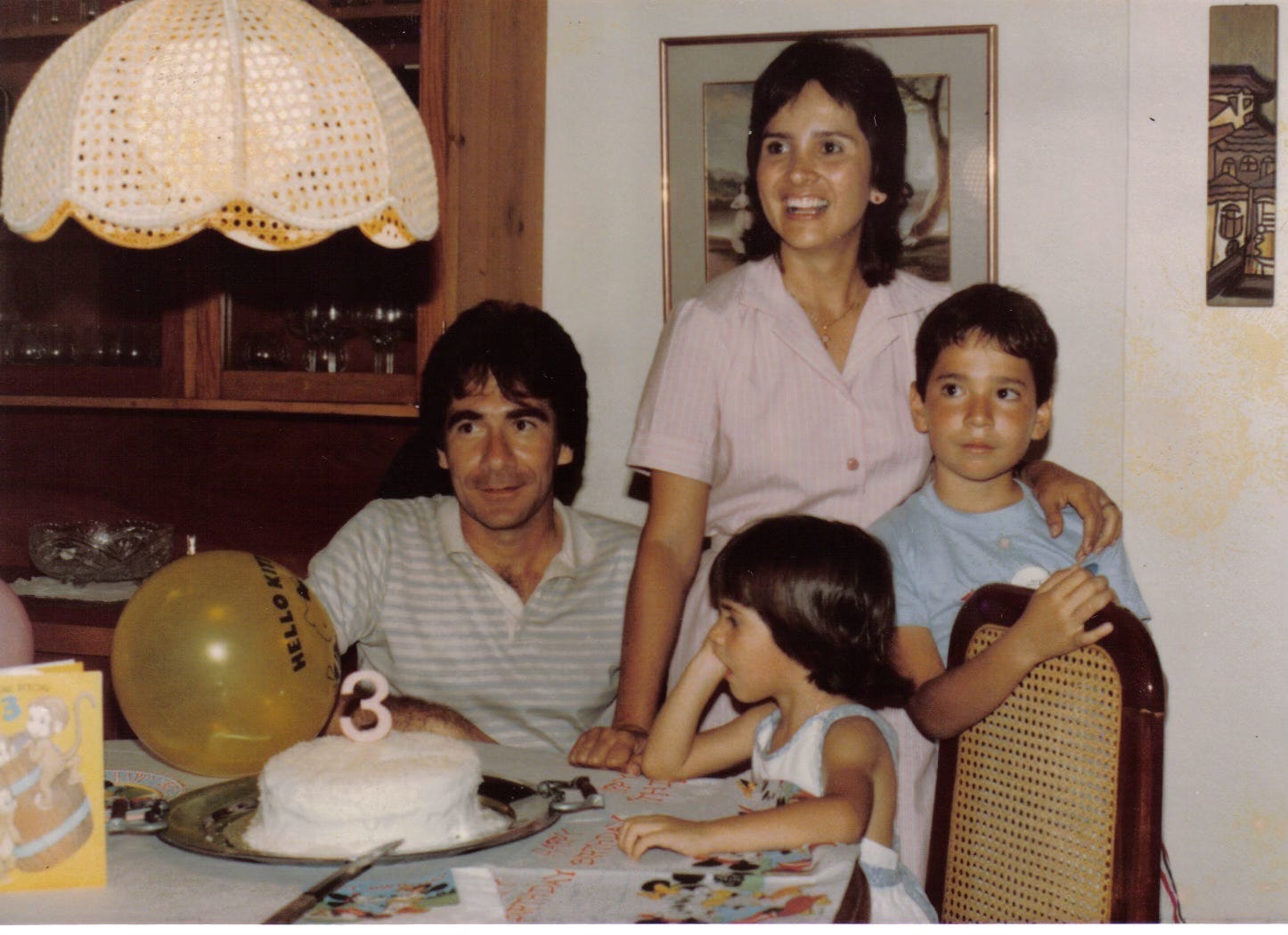
JM: I’ve thought about this so much. My dad’s an environmental engineer. My mom went back to school really late in life and ended up doing small business administration after me and my sister graduated from college. They weren’t exactly arts people, but we were surrounded by books when my sister and I were growing up. And if there’s something I was interested in, they would just get me books on it. They knew I loved to draw. So I was always immersed in art classes, but they were also cool and generous about buying supplies, even when dad was in grad school in the states and we didn’t have much money. It was always a very, very open childhood. It took me a moment to realize they were incredibly patient with me. But, it’s also taken me a whole life to realize that what happened to me at age 12 was traumatic—both for me and for my parents—and that they understood, on some level, that there was some emotional trauma that I was working through that I had not quite fully processed. They were incredibly open about the possibility that I could just be an artist, which is kind of a weird experience. Most writer friends I’ve talked to didn’t have the same kind of parental dynamic, but I didn’t know that. I just assumed all parents were like my parents. I didn’t know I was an outlier. I’ve talked to so many other writers and I don’t think I’ve ever quite felt they had the same level of support that I know in my heart I’ve always had.
JN: Do you try to bring that level of support to your parenting? Does it inspire you?
JM: I try to. The support was, is, continues to be enormously inspiring, and just helpful and really uplifting—how my parents believed that I could be a writer. It’s not like they weren’t concerned about the more practical side of my life, or the life of my sister, of course: they insisted that I needed to go to college—they made that very clear. And even though it took me a couple of tries to do so (I was a terrible undergraduate) they had this firm belief that if I wanted to do something and I loved it enough, then I’d be able to do it.
I do try carry that same bedrock belief in someone’s capacity to do anything, in the inherent, exciting possibilities of a rich life—I do try to impart that belief to my son and to my daughter. And I do appreciate that my parents pushed me to stick with college, to consider the practicalities of a professional life, despite my thinking that all I had to do, to be a writer, was read a lot and write a lot. And now I’m a college professor, which is in every way a dream job—one that I’m aware keeps on taking on more of the vanishing, evanescent qualities of a dream as higher ed continues to be assaulted on all fronts. I am a professor at a private, research-oriented university, right? But I’m also somebody who went to a state school and earned his PhD at a state school and taught at a few small liberal arts colleges. So I’ve had this weird experience of knowing what the ecosystem of higher ed is like. And I’m excited to show my son and daughter how you can navigate school to do whatever it is that you want to do. That’s been a weird gift of living a super peripatetic career in academia.
JN: That feeling of possibility your parents instilled in you seems so key to being able to take action and make things as an artist. You have to have that belief that work is valuable. That it matters.
JM: Now that we’re talking about this, I don’t think they realized they were doing this, they were kind of making it up as they went along, like we all do—and like we probably don’t realize until we have kids. Like, I really thought they had a plan. What they had instead was my dad’s obsession with the U.S. He was this poor kid from a town called Girardot, by the Magdalena River, the same river that runs through all of Colombia, that flows down all the way to the north of the country, right to where Gabriel García Márquez lived—and here’s my dad, this a scholarship kid who wins a Fulbright to go study in the U.S., but he has to give it up because he’s going to marry my mom. And then they have me almost immediately. His first job was in Curaçao, the Dutch Island in the Caribbean. And then he moves us all to Venezuela because that’s where all the jobs are. Actually half the Colombians—like, literally half my family—ends up in Venezuela because that’s where all the gigs were. And then eventually he said, “No, I want to go back to the U.S.” So he takes a whole family to go back to grad school in beautiful Akron, Ohio. And at this point, I think I’m like nine or ten. My sister is younger. He does his Masters in Akron U.
So it’s this incredible life where we’re ping-ponging back and forth between Colombia and Venezuela and then Ohio and then Colombia again. And then he moves us all back to the States so he can pursue his PhD in Orlando, and after he’s done I stay behind—I’m starting college as he’s finishing his PhD, we drove to campus together during his last year. And I remember, years later, at Christmas, my mom being very apologetic, crying or near tears, saying to me and my sister how bad she feels that we never settled down anywhere or had lifelong friends or whatever. And my sister and I were like, “It was an amazing life. We had so much fun.” We’d have a whole new adventure every couple of years. So even though my parents were not bohemian or artistic, they ended up giving us this incredibly rich, bohemian life—which, by the way, I did not appreciate at the time. I just thought it was boring—except Akron. I fell in love with Akron.
JN: (laughs) That’s a separate conversation.
JM: Oh my God. I could go on. First arcade game I ever played, first convenience-store Hostess apple pie—all Akron.
JN: I have to scurry to pick up my son from kindergarten, but would you share the 60-second version of the lunch bag doodles you make for your kids and share on Substack? I’m so besotted with them.
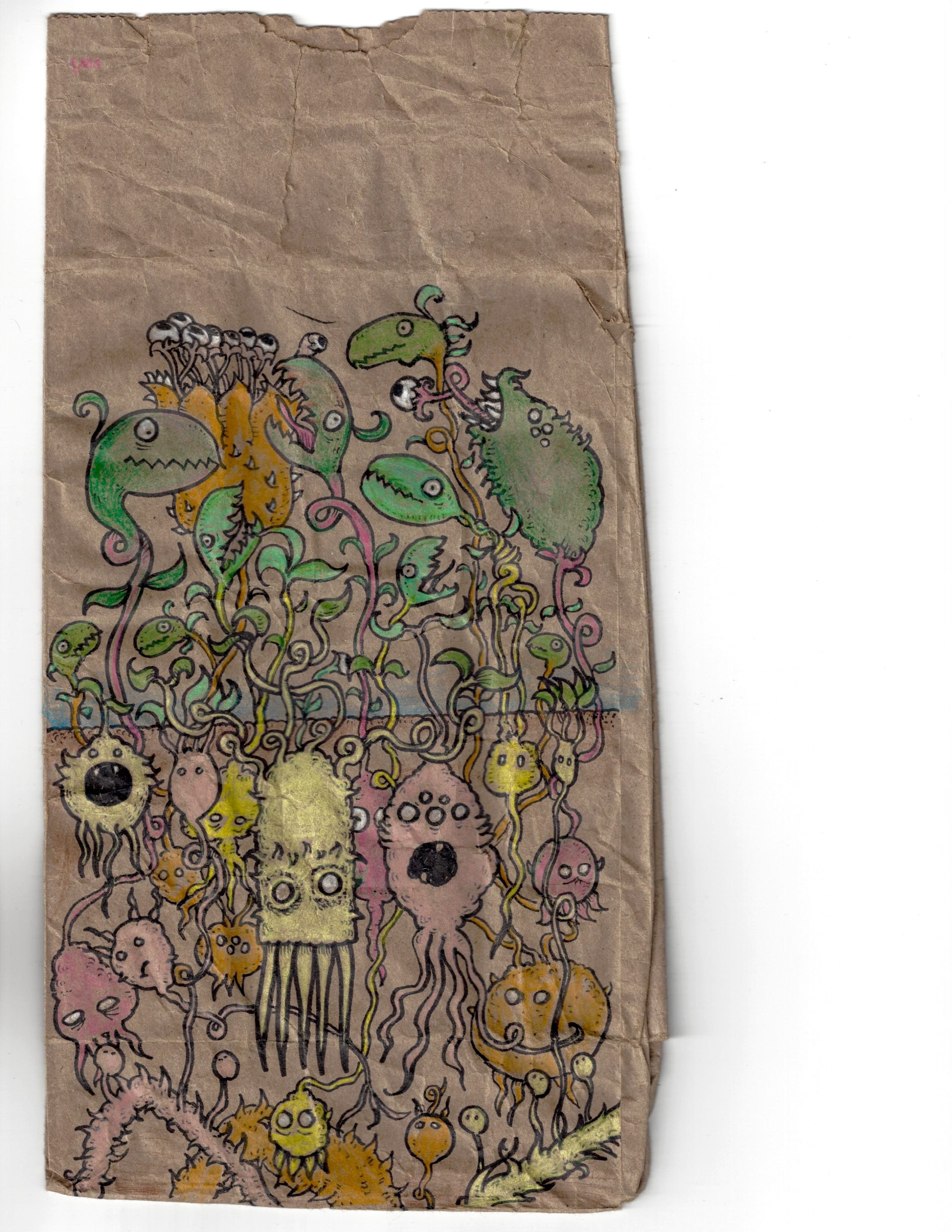
JM: I’m so glad you’re besotted with them! I’m besotted with them too! I love doing them. And it gives me joy. It gives my son joy. I love drawing and also—JoAnna, I know that you know what it’s like to work on long things—I love the fact that I can do a quick thing that gets out in the world, all while I’m working on this long thing, a thing that takes years of hunkering down and it being sort of invisible to anyone but yourself. And the doodles are a nice quick hit of art and dopamine and attention. But they’re a nice quick hit that also gets shared with one of the people that I love the most and then I’m done… It’s been a lifesaver. It’s been a lifesaver while in the middle of writing a novel, to have make a short fun bit of art that you’re like, “All right, I did it. It was fun and I’m done.”
JN: I think that’s the perfect place to conclude!
JM: I like the idea that you can make something beautiful, even if it’s tiny and fast because you have to go pick up your kids or, you know, pack them the sandwich that’s supposed to go in the bag you just doodled on.
 | A guest post by
|